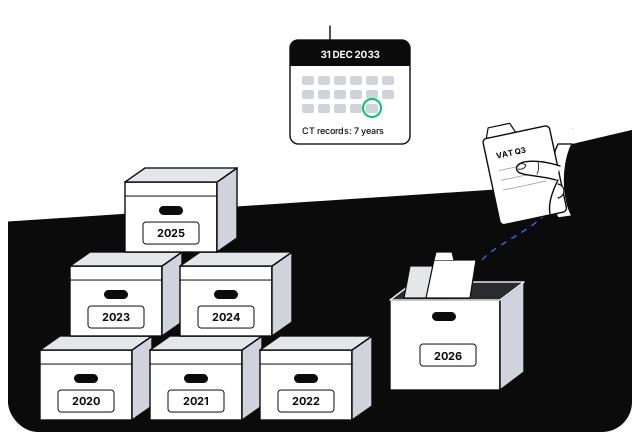
Keep tax records for at least 5 years after the end of the tax period for VAT, and 7 years for corporate tax (Article 56 of the Corporate Tax Law). VAT records about real estate need 15 years and capital asset records 10. An audit or dispute adds 4 years. In practice, keep everything at least 7 years.
Facts checked 20 Nov 2026 against FTA and Ministry of Finance sources listed at the end. Not tax or legal advice.
Upload a bank statement and your receipts. No sign-up, deleted after 24 hours.
Or start free, no cardThe question I get most from owners clearing out an office or moving to a free zone is "can I bin the 2019 files?". The honest answer depends on which law the paper supports, when that tax period ended and whether the FTA has been in touch. Below are the actual periods, where they come from, and a simple rule that covers almost every small business.
How long do you have to keep records in the UAE?
The base rule is 5 years after the end of the tax period, from the Executive Regulation of the Tax Procedures Law. Specific laws then set longer periods: 7 years for corporate tax, 15 years for VAT real estate records and 10 years for VAT capital asset records.
| Records | Minimum period | Clock starts | Source |
|---|---|---|---|
| VAT and other tax records of a taxable person | 5 years | End of the tax period | Cabinet Decision 74 of 2023, Art. 3(1)(a); VAT Exec. Reg. Art. 71(1) |
| Corporate tax records (taxable and exempt persons) | 7 years | End of the tax period (financial year) | Corporate Tax Law, Art. 56 |
| VAT records relating to real estate | 15 years | End of the tax period | VAT Exec. Reg. Art. 71(2) |
| VAT records for capital assets | At least 10 years | Not specified in the article | VAT Law, Art. 60(2) |
| Real estate records (general rule, where a tax law sets nothing else) | 7 years | End of the calendar year the document was created | Cabinet Decision 74 of 2023, Art. 3(1)(c) |
| Records of a person who is not a taxable person | 5 years | End of the calendar year the document was created | Cabinet Decision 74 of 2023, Art. 3(1)(b) |
| Company accounting registers | At least 5 years, at the head office | End of the financial year | Companies Law (Decree-Law 32 of 2021), Art. 26 |
When does the retention clock start?
For VAT and corporate tax, the clock starts at the end of the tax period the record relates to, not on the invoice date. A VAT quarter and a corporate tax year end on different dates, so the same document can have two deadlines.
A DEWA tax invoice dated 15 February 2026, for a company with quarterly VAT periods and a calendar financial year:
- VAT: the Q1 tax period ends 31 March 2026. Keep until at least 31 March 2031.
- Corporate tax: the 2026 tax period ends 31 December 2026. Keep until at least 31 December 2033.
- The longer date wins: the invoice stays in the archive until 2034.
When do you have to keep records for longer?
Article 3(2) of Cabinet Decision 74 of 2023 adds extra time on top of the base periods in specific situations. If any of these apply to a period, do not destroy anything from it.
- Dispute with the FTA: 4 more years, or until the dispute is finally settled, whichever is later.
- Ongoing tax audit: 4 more years.
- Audit notified before the period ran out: 4 more years.
- Voluntary disclosure filed in the fifth year: 1 more year from the date it was submitted.
- Refund application not yet decided: 2 more years. This was added by Cabinet Decision 17 of 2026, in force from 1 April 2026.
- Legal representatives (for example, a liquidator) keep the records of the person they represent for 1 year after the representation ends.
These line up with the FTA's own time limits. Under Article 46 of the Tax Procedures Law, the FTA cannot normally audit or assess a period after 5 years from its end, but it has 15 years where there was tax evasion or a failure to register. If you registered for VAT late, the records from the date you should have registered are the ones that matter.
Which records do you have to keep?
Everything that shows money in and out, and the documents that support it. Article 2 of Cabinet Decision 74 of 2023 lists the accounting records; Article 78 of the VAT Law adds VAT-specific ones; Article 56 of the Corporate Tax Law requires anything that supports the return and lets the FTA work out taxable income.
Accounting records and books
- Records of payments and receipts, purchases and sales, revenue and expenditure.
- Balance sheet and profit and loss account.
- Records of wages and salaries.
- Fixed asset records.
- Inventory records at the end of each tax period, with stock-count records.
Supporting documents
- Correspondence, invoices, licences and contracts related to the business.
- Documents showing any election, assessment or calculation for tax, such as your Small Business Relief election or how you split a mixed-use cost.
VAT-specific records (Article 78)
- All tax invoices and credit notes issued and received, plus alternative documents.
- Records of supplies and imports of goods and services, and of exports.
- Records of goods and services used for non-business purposes, and of purchases where input VAT was not claimed.
- Records of adjustments and corrections to accounts or invoices.
- Documents for supplies under the reverse charge, such as Google and Meta ad invoices.
- A tax record summarising output tax, reverse-charge tax, recoverable tax and corrections for each period.
A bank statement alone is not enough. It shows a payment, not what was bought or whether VAT was charged. See bank reconciliation for how statements and invoices fit together.
Can you keep records digitally, and in English?
Yes to both, with conditions. Article 4 of Cabinet Decision 74 of 2023 accepts either the original documents or an electronic or photocopy record that is identical to the original, kept for the whole period and reproducible in a readable form when the FTA asks.
- Scans and PDFs: fine if complete and legible. A blurry phone photo of a thermal receipt that has faded is not.
- Response time: when the FTA asks for documents and the law sets no specific deadline, it gives between 5 and 40 business days (Article 48 of the Tax Procedures Law). Records you cannot find in that time are as good as missing.
- Language: English is accepted, but the FTA can ask for an approved Arabic translation (Article 5 of the Tax Procedures Law and of Cabinet Decision 74). Not providing it costs AED 5,000.
- Location: the Companies Law expects accounting registers to be kept at the company's head office, with electronic copies allowed under ministerial controls. If you hold records with a cloud provider, make sure you control the account, not a former employee.
A FTA Audit File (FAF) is the standard export the FTA can request from accounting software during an audit. Keep in mind that your software subscription may end before the retention period does.
What happens if records are missing?
The fixed penalty is AED 10,000 for each violation and AED 20,000 for a repeat, both for VAT (Cabinet Decision 40 of 2017, as amended by Cabinet Decision 129 of 2025) and corporate tax (Cabinet Decision 75 of 2023). The larger cost is usually indirect:
- Input VAT without a valid tax invoice on file can be denied.
- Expenses you cannot support may be disallowed for corporate tax.
- Where records are incomplete, the FTA can assess based on the information it has, and you have to disprove it.
If you are already missing years, see the catch-up guide before an audit letter arrives, and read about VAT penalties and voluntary disclosures.
Common mistakes
- Counting 5 years from the invoice date instead of from the end of the tax period.
- Applying the 5-year VAT rule to records that also support a corporate tax return (7 years).
- Deleting files during an audit or while a refund claim is still open.
- Keeping invoices in an employee's personal inbox or WhatsApp, which leaves with them.
- Relying on a software subscription or an outsourced accountant to hold the only copy.
- Throwing out property purchase and lease files early. VAT records relating to real estate need 15 years; if unsure whether a file counts, keep it.
How fylng handles this
fylng helps you build complete records in the first place: it reads bank statements, receipts and invoices, ignores duplicate uploads, flags statement gaps where the running balance does not follow on, matches documents to bank lines and checks supplier TRNs, so each VAT201 figure points to a document. Missing invoices show up as issues with the AED of input VAT at stake.
What it is not yet: a long-term archive. fylng accounts are live; UAE-region hosting is coming soon, and the FTA Audit File (FAF) export is coming soon. Keep your own copies of statements and invoices in storage you control, organised by year, for the periods in the table above.
FAQ
How many years do I need to keep VAT records in the UAE?
At least 5 years after the end of the tax period they relate to. Records about real estate must be kept for 15 years, and records for capital assets for at least 10 years under Article 60 of the VAT Law. The period is extended if the FTA notifies or runs an audit.
How long must corporate tax records be kept?
7 years following the end of the tax period they relate to, under Article 56 of the Corporate Tax Law. This applies to taxable persons and to exempt persons, who must keep records showing their exempt status.
Can I keep my records only in digital form?
Yes. Cabinet Decision 74 of 2023 allows records to be kept as electronic copies, provided the information is identical to the original, available for the whole retention period and can be reproduced in a readable form when the FTA asks.
Do my records have to be in Arabic?
No. The FTA may accept records in English but can ask you to translate some or all of them into Arabic through an approved translation. Failing to provide Arabic translations when requested carries an AED 5,000 penalty.
What is the penalty for not keeping records in the UAE?
AED 10,000 for each violation and AED 20,000 for a repeat, for both VAT and corporate tax. Missing records can also lead to assessments based on estimates and to denied input VAT.
Can I throw away records once 5 years have passed?
Only if they are not needed for anything longer. The same invoice usually supports a corporate tax return too, which needs 7 years, and the periods are extended by 4 years during an audit or dispute. Most small businesses should simply keep everything for at least 7 years.
Does the FTA time limit for audits match the record-keeping period?
Broadly. The FTA cannot normally audit or assess after 5 years from the end of the tax period, but that rises to 15 years in cases of tax evasion or failure to register. If you registered late, keep records from the date you should have registered.
Sources
- Cabinet Decision 74 of 2023 (Executive Regulation of the Tax Procedures Law) and its amendments, Articles 2 to 5, FTA (checked 20 Nov 2026)
- Amendments to the Tax Procedures Executive Regulation effective April 2026 (Cabinet Decision 17 of 2026), Ministry of Finance (checked 20 Nov 2026)
- Federal Decree-Law 28 of 2022 on Tax Procedures, as amended, Articles 4, 5, 46 and 48, FTA (checked 20 Nov 2026)
- Federal Decree-Law 8 of 2017 on VAT, as amended, Articles 60 and 78, FTA (checked 20 Nov 2026)
- VAT Executive Regulation, Article 71 (record-keeping, 15 years for real estate), FTA (checked 20 Nov 2026)
- Get to know your tax obligations (5 years; 15 years for real estate), FTA (checked 20 Nov 2026)
- Federal Decree-Law 47 of 2022 on Corporate Tax, Article 56, Ministry of Finance (checked 20 Nov 2026)
- Cabinet Decision 40 of 2017 on administrative penalties, as amended, Ministry of Finance (checked 20 Nov 2026)
- Cabinet Decision 75 of 2023 on corporate tax penalties, as amended, Ministry of Finance (checked 20 Nov 2026)
- Federal Decree-Law 32 of 2021 on Commercial Companies, Article 26, Ministry of Economy and Tourism (checked 20 Nov 2026)