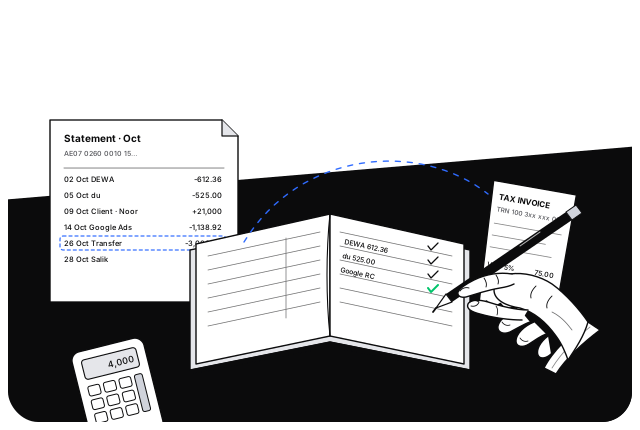
Every UAE business must keep accounting records plus the documents behind them: bank statements, sales and purchase invoices, receipts, contracts and payroll. Keep them at least 5 years for VAT and 7 years for corporate tax. In practice: one business bank account, a monthly routine that sorts and matches every line, and figures you can prove.
Facts checked 20 Nov 2026 against FTA and Ministry of Finance sources listed at the end. Not tax or legal advice.
Upload a bank statement and your receipts. No sign-up, deleted after 24 hours.
Or start free, no cardMost small businesses I see in the UAE do not have a bookkeeping problem. They have a pile: three bank accounts, a Noon seller payout report nobody opened, Careem receipts sitting in an inbox and a folder called "invoices 2025 FINAL". The law does not ask for anything fancy. It asks that every number you report can be traced back to a document. This guide covers exactly what that means and the smallest routine that gets you there.
What records does a UAE business have to keep?
You must keep your books (the record of money in and out, sales and purchases, income and expenses) and every document that supports an entry in them. The list comes from Article 2 of Cabinet Decision 74 of 2023, the Executive Regulation of the Tax Procedures Law, and Article 78 of the VAT Law adds VAT-specific records on top.
| Record | Typical UAE example | Why it matters |
|---|---|---|
| Bank and card statements | Emirates NBD, FAB, Wio, Mashreq exports for every account | The backbone: every other record should tie back to a bank line |
| Sales invoices and credit notes issued | Your tax invoices to clients, refunds as credit notes | Output VAT and revenue for corporate tax |
| Purchase invoices and receipts | DEWA bill, e& invoice, Carrefour receipt for office supplies | Input VAT needs a valid tax invoice; expenses need proof |
| Imports and reverse-charge documents | Google Ads and Meta invoices from Ireland, customs declarations | Reverse-charge boxes on the VAT return |
| Payroll records | WPS salary files, contracts, visa costs | Wages are a named record in Cabinet Decision 74 |
| Fixed assets register | Laptops, a delivery van, fit-out | Depreciation, and capital asset VAT records (10 years) |
| Stock records | Year-end stock count with quantities and values | Required where you hold inventory |
| Contracts, licences, correspondence | Trade licence, tenancy contract, supplier agreements | Show what a payment was for |
For the full retention rules, including the 15-year rule for VAT real estate records, read how long UAE businesses must keep records.
Do you need bookkeeping if you are not VAT registered?
Yes. Article 4 of the Tax Procedures Law says any person conducting business must keep accounting records and commercial books. VAT registration only decides whether you also keep VAT records.
Three other rules catch businesses below the AED 375,000 VAT threshold:
- Corporate tax. Every UAE company is a taxable person and files a return, even at 0% tax or under Small Business Relief. A natural person (freelancer or sole establishment owner) comes in once business turnover passes AED 1,000,000 in a calendar year (Cabinet Decision 49 of 2023). Corporate tax records must be kept for 7 years.
- Companies Law. Article 26 of Federal Decree-Law 32 of 2021 requires every company to keep accounting registers at its head office for at least 5 years from the end of the financial year, and Article 27 requires LLCs to appoint an auditor. Free zones apply their own regulations on top.
- Voluntary VAT registration. Above AED 187,500 of supplies or expenses you may register voluntarily, which only makes sense if your books can support a quarterly return.
Cash basis or accrual: which method can you use?
For corporate tax, a business with revenue of AED 3,000,000 or less may prepare its financial statements on a cash basis (Ministerial Decision 114 of 2023). Above that, you use accrual accounting, with IFRS for SMEs allowed up to AED 50,000,000 of revenue.
Cash basis is simpler: income counts when the money lands, expenses when they leave. But VAT never follows your accounting method. Under Article 25 of the VAT Law, VAT is due on the date of supply, which is generally the earliest of delivery, payment received or the tax invoice date. So even a cash-basis business keeps a list of invoices issued, because a December invoice paid in February belongs in the Q4 VAT return.
What does a good monthly bookkeeping routine look like?
Close each month within two or three weeks of it ending, in the same six steps. A month of 60 to 150 bank lines takes an hour or two once the habit exists; a year left to the end takes days and leaves gaps nobody can fill.
- Download every statement. All bank accounts, business credit cards, and payout reports from Stripe, Noon, Amazon.ae, Talabat or whichever platform pays you. Use the CSV or Excel export, not a screenshot.
- Check the statement is complete. The closing balance of March must equal the opening balance of April. If the running balance jumps, a page or a date range is missing.
- Sort every line into an account. DEWA to utilities, e& to telecom, Salik to tolls, the AED 3,000 transfer to "Ahmed" to subcontractor, salary or owner drawings. If you cannot say what a line was, that is the question to answer now, not in a year.
- Match receipts and invoices. Each purchase line with VAT on it should have a valid tax invoice attached. Each sales receipt should match an invoice you issued. This is bank reconciliation in practice.
- Chase what is missing. A supplier invoice without a TRN, a Meta Ads charge with no invoice downloaded, a cash payment with only a WhatsApp message. Ask the same week.
- Lock the month. Note the closing balances, save the documents in a dated folder, and do not edit a closed month without a note of why.
Which accounts does a small UAE business actually need?
Twenty to forty accounts is plenty for a small business. What matters is that each one carries a clear VAT and corporate tax treatment, so sorting a line also answers the tax question.
| Account | Typical lines | VAT | Corporate tax |
|---|---|---|---|
| Utilities | DEWA, SEWA, ADDC, Empower | 5%, recoverable with tax invoice | Deductible |
| Telecom | e&, du | 5%, recoverable | Deductible (business share) |
| Local transport | Careem, taxi, Nol top-ups | Local passenger transport is exempt | Deductible |
| Advertising | Google Ads, Meta, LinkedIn | Reverse charge when billed from abroad | Deductible |
| Client entertainment | Client dinners | Input VAT blocked | 50% deductible |
| Government fees | Licence renewal, visa fees | Generally no VAT | Deductible |
| Fines | RTA parking fines, late filing penalties | No VAT | Not deductible |
| Owner drawings | Personal spend from the business account | No input VAT | Not an expense |
The last row is where most small business books go wrong. If you also pay business costs from a personal card, read how to fix personal and business expenses in your books.
Worked example: one month for a Dubai design studio
An illustrative two-person studio, VAT registered, one Emirates NBD account. October has 64 bank lines: 9 client receipts totalling AED 84,000 including VAT, 41 card payments, 11 transfers and 3 bank charges.
- The export opens with 6 rows of account details before the real column headers. Delete nothing; just note where the table starts.
- Running balance check: the 14 Oct line shows AED 31,240.50 but the 13 Oct balance minus the 14 Oct debit gives AED 33,240.50. Someone exported two date ranges and one AED 2,000 line is missing. Re-export the full month.
- Sorting: 36 lines are obvious (DEWA AED 612.36, du AED 525, Adobe, Google Ads USD 300 charged as AED 1,138.92 on the card). 5 need a question, such as "AED 3,000 transfer to M. Khan on 26 Oct: freelancer or salary?"
- Matching: 33 of 41 card payments have a receipt. The 8 missing include a AED 1,575 printing invoice that shows no TRN. Without a valid tax invoice the AED 75 VAT on it cannot be recovered.
- Result: October closes with AED 4,000 of output VAT on sales and AED 1,290 of recoverable input VAT, every figure traceable to a document.
How much does bookkeeping cost a small UAE business?
Outsourced bookkeeping in the UAE is usually priced by monthly transaction volume. Published packages for small businesses mostly fall between about AED 500 and AED 3,000 a month, with VAT and corporate tax filings sometimes extra. The full comparison of accountants, software and a mix of both is in accountant, software or both.
Common bookkeeping mistakes in UAE small businesses
- Running business and personal spend through one account and sorting it out "at year end".
- Keeping only the bank statement. A bank line proves you paid; it does not prove what you bought or that VAT was charged.
- Claiming input VAT from receipts without the supplier's TRN, or from a supermarket slip for groceries that were not for the business.
- Forgetting accounts: a second card, a PayPal balance, a USD account, a marketplace wallet.
- Booking VAT on the payment date when the invoice was issued in the previous quarter.
- Leaving a whole year unbooked. If that has already happened, a structured catch-up is faster than starting from January and hoping.
- Saving documents only in a phone gallery or a staff member's personal email, where they disappear when that person leaves.
How fylng handles this
fylng is built around the monthly routine above. You upload bank exports (CSV, Excel or PDF), receipt photos and invoices. The statement reader finds the header row below the bank's preamble, reads UAE day-first dates and debit/credit columns, ignores a file you already uploaded and flags places where the running balance does not follow on, which is how missing pages show up.
Each line is sorted into a 39-account chart that carries its VAT and corporate tax treatment, with built-in rules for merchants such as DEWA, e&, du, Salik, Careem, ENOC and Google or Meta (reverse charge). Supermarket and restaurant spend is sent to you as a question rather than guessed. Receipts are matched to bank lines by amount, date window, FX tolerance and supplier name, and supplier TRNs are checked for the 15-digit format. Anything unclear arrives as a plain question, such as "What was AED 3,000 on 26 Oct for?". AI reading of PDFs and photos is built and still being tested. Gmail and WhatsApp receipt intake is coming soon.
FAQ
Do I need to keep books if my business is not registered for VAT?
Yes. The Tax Procedures Law requires any person conducting business to keep accounting records and commercial books, and every UAE company and many sole establishments also fall under corporate tax. VAT registration only adds VAT-specific records on top.
How long do I have to keep my business records in the UAE?
At least 5 years after the end of the tax period for VAT and general tax records, and 7 years for corporate tax under Article 56 of the Corporate Tax Law. VAT records about real estate must be kept for 15 years. The period is extended if the FTA opens an audit.
Can a small UAE business use cash-basis accounting?
For corporate tax, yes, if revenue does not exceed AED 3,000,000 (Ministerial Decision 114 of 2023). VAT is different: it follows the date of supply, which is the earliest of delivery, payment or the tax invoice date, so you still track invoices for VAT.
Is Excel acceptable for bookkeeping in the UAE?
The law does not name any software. Records must be complete, kept for the required period and reproducible in a readable form when the FTA asks. A well-kept spreadsheet backed by bank statements and invoices meets that; a spreadsheet with no source documents does not.
What is the penalty for not keeping proper records in the UAE?
AED 10,000 for a first violation and AED 20,000 for a repeat, under Cabinet Decision 40 of 2017 as amended (VAT and tax procedures) and Cabinet Decision 75 of 2023 (corporate tax). Not providing Arabic translations when asked costs AED 5,000.
How often should a small business do its bookkeeping?
Monthly is the practical minimum. VAT returns are usually quarterly and due 28 days after the period ends, and a month of transactions takes far less time to sort while you still remember what each payment was for.
Sources
- Cabinet Decision 74 of 2023 (Executive Regulation of the Tax Procedures Law) and amendments, Articles 2 to 5, FTA (checked 20 Nov 2026)
- Federal Decree-Law 28 of 2022 on Tax Procedures, as amended, Article 4, FTA (checked 20 Nov 2026)
- Federal Decree-Law 8 of 2017 on VAT, as amended, Articles 25 and 78, FTA (checked 20 Nov 2026)
- Federal Decree-Law 47 of 2022 on Corporate Tax, Article 56, Ministry of Finance (checked 20 Nov 2026)
- Ministerial Decision 114 of 2023 on accounting standards and methods, Ministry of Finance (checked 20 Nov 2026)
- Ministerial Decision 84 of 2025 on audited financial statements, Ministry of Finance (checked 20 Nov 2026)
- Cabinet Decision 40 of 2017 on administrative penalties, as amended, Ministry of Finance (checked 20 Nov 2026)
- Cabinet Decision 49 of 2023 on natural persons (AED 1,000,000 turnover), Ministry of Finance (checked 20 Nov 2026)
- Federal Decree-Law 32 of 2021 on Commercial Companies, Articles 26 and 27, Ministry of Economy and Tourism (checked 20 Nov 2026)
- VAT registration thresholds, FTA (checked 20 Nov 2026)