fylng / Industries / Trading and wholesale
Accounting software for trading companies in the UAE
Buy anywhere.
Sell everywhere.
You pay a supplier in Shenzhen by TT, the container lands at Jebel Ali, Dubai Customs takes the duty, half the stock goes to a retailer in Sharjah and half is trucked to Muscat. A phone distributor sends an invoice with no VAT on it. fylng sorts every one of those lines under UAE rules, so your VAT201 shows imports, local sales and exports in the right boxes.
A UAE trading company charges 5% VAT on local sales and pays 5% import VAT on the customs value plus duty. A VAT-registered importer reports import VAT in box 6 and recovers it in the same return, while customs duty is a stock cost with no VAT. Exports are zero-rated with exit proof within 90 days, goods in transit or a customs warehouse are not imported yet, and phones, laptops, gold, precious stones and metal scrap sold between registered businesses use reverse charge.
Key facts for trading companies
What the bank feed does not show
A service business mostly buys and sells inside the UAE. A trader moves goods across borders, through customs and in and out of zones, often in three currencies. Here is what the bank statement does not tell you.
Stock is not an expense
A TT of USD 26,000 to a supplier in China buys stock, not costs. It becomes cost of sales only when the goods are sold. Book it as an expense and your profit swings every quarter.
Customs bills mix two things
Dubai Customs, the clearing agent or the courier collects duty, import VAT, handling and fees in one payment. Duty belongs in stock cost; import VAT belongs in box 6. One line on the statement, two very different treatments.
Exports without paperwork
A truck to Oman or a container to Africa is zero-rated only if you keep the exit proof. Without it the FTA treats the sale as local and asks for 5%, often years later in an audit.
"No VAT on this invoice"
Phone and laptop distributors, gold suppliers and scrap dealers may correctly charge you no VAT. That is reverse charge: you report the 5% yourself. Miss it and your return is wrong even though no money changed hands.
Three currencies, one ledger
Suppliers paid in USD or CNY, customers paying in AED and SAR, bank charges and exchange differences on every TT. The invoice, the bank line and the VAT figure each need an AED value.
Credit terms and rebates
Wholesale runs on 30 to 90 days' credit, post-dated cheques, volume rebates and customers who never pay. Each one changes when VAT is due or lets you claim some of it back.
The UAE rules that matter for traders
The law is the same for every business; these are the parts a trading ledger meets every month. Each rule links to the official text.
Import VAT is 5% of the customs value plus duty
The value of an import is the customs value, including insurance, freight, customs fees and any excise tax (Article 35 of the VAT Decree-Law). A registered importer that gives its TRN and its own customs code accounts for the VAT by reverse charge: output in box 6, input in box 10 in the same return (Executive Regulation, Article 48). If those conditions are not met, the VAT is paid before the goods are released (Article 50). [1][2]
Example. CIF value 80,000, duty 5% = 4,000, import VAT 5% of 84,000 = 4,200 in box 6 and 4,200 back in box 10.
Customs duty is a cost, and suspended goods are not imported yet
Duty is not VAT and never goes in a VAT box; it is part of the cost of your stock. Goods in transit, in a customs warehouse, under temporary admission or brought in to be re-exported by the same person are not treated as imported while they stay under customs suspension (Executive Regulation, Article 47). Import VAT falls due only when they are released into the UAE. [2]
Designated zones are outside the UAE for goods, not for services
A designated zone on the Cabinet list, such as parts of Jebel Ali Free Zone, is treated as outside the State for goods (Article 50 of the Decree-Law). Goods can move between designated zones without VAT under customs suspension, but goods consumed in the zone, and all services there, are inside the UAE (Executive Regulation, Article 51). Moving goods from the mainland into a zone is not an export (Article 30, Clause 3). Not every free zone is a designated zone. [1][2]
Exports: zero-rated with exit proof within 90 days
Goods shipped outside the UAE are zero-rated if they leave within 90 days of supply and you keep a customs declaration plus commercial evidence (bill of lading, airway bill or land manifest), or official exit evidence (Executive Regulation, Article 30). If an overseas customer collects the goods, the export is indirect: the customer must give you a copy of the exit documents. Without proof in time, 5% is due as if the sale were local. [2]
Example. A truck to Muscat on 3 July needs its exit certificate and land manifest on file by 1 October.
Phones, tablets and computers: domestic reverse charge
Since 30 October 2023, mobile phones, smartphones, computers, tablets and their parts sold between VAT-registered businesses for resale or manufacture use reverse charge. The supplier charges no VAT and states the reverse charge on the invoice; the buyer reports 5% in box 3 and, if fully taxable, recovers it in box 10. Since 1 January 2026 the buyer keeps the invoice and payment record and no longer issues a self-invoice. [3][11]
Gold, silver, platinum and precious stones: reverse charge too
Cabinet Decision No. 127 of 2024 widened the old gold and diamond rule to precious metals (gold, silver, platinum, palladium) and precious stones (diamonds, pearls, rubies, sapphires, emeralds), and jewellery where they make up most of the value, sold between registrants for resale or manufacture. Investment gold, silver and platinum of 99% purity in bullion form are zero-rated instead (Executive Regulation, Article 36). Dealers also have AML duties for cash sales of AED 55,000 or more. [4][2]
Metal scrap and oil products: reverse charge between registrants
From 14 January 2026, metal scrap sold between registrants for resale or processing is reverse charged (Cabinet Decision No. 153 of 2025): the buyer gives a written declaration before the supply, the seller checks the buyer's TRN and writes the reverse charge on the invoice. Crude and refined oil, natural gas and pure hydrocarbons bought for resale or energy work the same way under Article 48, Clause 3 of the Decree-Law. Paper, plastic and other scrap stay at the normal 5%. [5][1]
Rebates, returns and bad debts change your VAT
A volume rebate or a return reduces the value of the original sale only when you issue a tax credit note (Executive Regulation, Articles 28 and 60). A customer who never pays lets you reclaim the output VAT once the debt is written off, more than six months have passed since the supply and you have told the customer (Article 64 of the Decree-Law). A post-dated cheque does not delay VAT: it is due on the earlier of invoice, delivery or payment (Article 25). [1][2]
Corporate tax: accrual accounts once revenue passes AED 3 million
Taxable income above AED 375,000 is taxed at 9%. Revenue of AED 3 million or less can use Small Business Relief for periods ending by 31 December 2029, and may use cash-basis accounts; above that, accounts must be on an accrual basis (Ministerial Decision No. 114 of 2023). For a trader that means year-end stock counts, receivables and payables. Sales to a sister company or the owner's other business must be at market value (CT Law, Articles 34 and 36). [6][7][9]
Free zone traders: only some trading qualifies for 0%
A Qualifying Free Zone Person pays 0% on qualifying income. For traders the qualifying activities are trading of qualifying commodities with a quoted price (metals, minerals, energy, agriculture) and distribution of goods in or from a designated zone to customers who resell or process them (Ministerial Decision No. 229 of 2025). Selling to mainland end users or consumers is generally not qualifying, and too much of it can cost the 0% rate for the whole company. [6][8]
Is your free zone a designated zone, and is your warehouse inside the fenced customs area? The answer changes the VAT on every sale. Check the Cabinet list on the FTA website and your licence before you set up the books.
Your trade, sorted line by line
This is how a quarter looks for a sample trading company in fylng. Each bank line gets a category, a VAT treatment and a status, and anything unclear becomes a plain question.

What was AED 38,000 to Gulf Star Electronics on 14 Jul for?
- Duty apart from VATCustoms and courier payments are flagged so duty goes to stock cost and only the 5% import VAT reaches box 6.
- Exports with a clockEach zero-rated sale is marked until its exit proof is matched.
- Reverse charge spottedA supplier invoice with no VAT on phones, gold or scrap becomes one question, not a silent gap in boxes 3 and 10.
Sample company and figures, for illustration. The screens follow the fylng app layout.
Following one container through the return
The figures below are an example, not a real trader. They show how one import splits into stock cost, import VAT, local sales and exports.
Example: 2,000 units in, 1,000 sold locally, 1,000 exported
A Deira trading company, VAT registered with its own customs code, imports one container and sells it within the quarter.
Landed cost of the stock is 84,000 (goods plus duty), so gross profit is 140,000 minus 84,000 = 56,000. The import VAT costs nothing in cash because it is reported and recovered in the same return. If the exit certificate for the Muscat truck is not on file within 90 days, another 3,500 becomes due. Had the duty been booked in box 6 as if it were VAT, the return would show 4,000 of imports that never carried VAT.
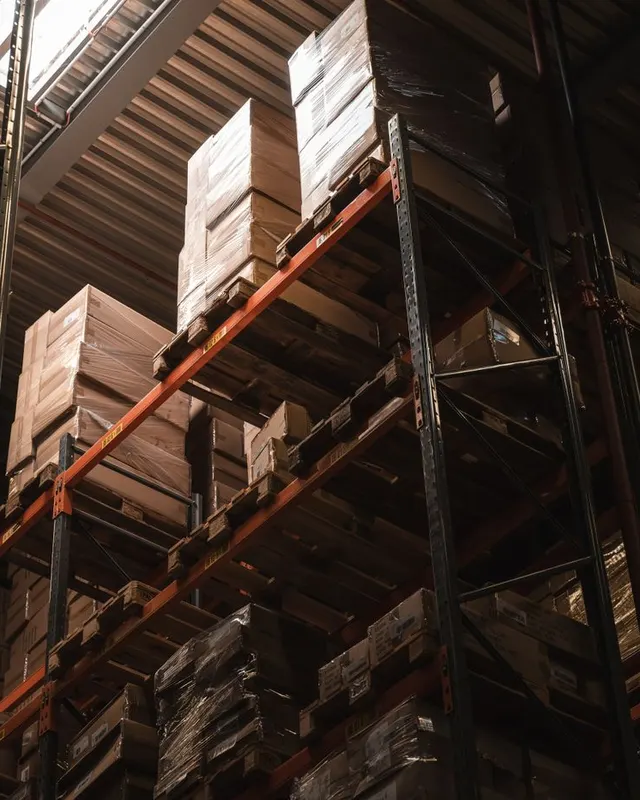
Every carton on the rack came through a TT, a customs entry or a supplier invoice. The books should show where it came from and where it went.
Photo: Ryan Klaus on PexelsWhere the goods go, what you charge
Most trading mistakes come from treating every sale the same. The destination and the customer decide the VAT, and each one needs its own proof.
| Sale | VAT | Proof you keep | Return |
|---|---|---|---|
| Local customer, mainland | 5% | Tax invoice with your TRN (and theirs if registered) | Box 1 by emirate |
| Phones, laptops, gold, scrap to a registered reseller | No VAT charged; buyer reverse charges | Invoice stating reverse charge, buyer's TRN check, declaration for scrap | Buyer: boxes 3 and 10 |
| Export you ship (GCC or beyond) | 0% | Customs declaration plus bill of lading, airway bill or land manifest within 90 days | Box 4 |
| Overseas customer collects (ex-works) | 0% if exported in 90 days | Copy of the customer's exit documents, agreed before supply | Box 4, or 5% if no proof |
| Goods sold inside a designated zone for re-export | Outside the scope | Customs evidence that the goods left the zone | Not reported as UAE sales |
| Goods from the mainland into a free zone company | 5% (not an export) | Normal tax invoice | Box 1 |
| Re-export from a customs warehouse or transit | No import VAT while suspended | Customs suspension and exit declarations | Nothing in box 6 until released |
What fylng does for traders
Straight answer on what works today and what is on the way.
Working today
- Reads bank statements from any UAE bank (CSV, Excel, PDF), including TT and cheque lines, and flags gaps in the running balance
- Sorts supplier TTs, customs payments, freight, fuel and bank charges to their own accounts, and turns unclear ones into a plain question
- Matches supplier and customer invoices to bank lines by amount, date window, currency tolerance and name; supplier TRN checked
- No input VAT claimed without a valid tax invoice: missing ones show up as issues with the AED at stake
- Reverse charge in boxes 3 and 10 for foreign services and supplier invoices with no VAT
- VAT201 values box by box and by emirate, a readiness score, and a corporate tax estimate with Small Business Relief check
Before you file your next VAT return
Work through it once a quarter. Your ticks stay in this browser.
Mistakes we see most often
Putting customs duty in box 6
Duty is a cost of the goods. Only the 5% import VAT belongs in box 6.
Zero-rating exports without exit proof
A sales invoice to a foreign buyer is not proof. No exit document within 90 days means 5% is due.
Ignoring invoices with no VAT
A phone or gold supplier not charging VAT means you report it. Leaving boxes 3 and 10 empty is an incorrect return.
Treating a free zone as abroad
Only designated zones are outside the UAE, and only for goods. Mainland to free zone is a local sale.
Expensing stock when it is paid for
Stock is an asset until sold. Expensing the TT distorts profit and the corporate tax figure.
Reducing VAT for a rebate without a credit note
A deduction on a customer statement is not enough. Issue a tax credit note.
Free file tools from FixDoks, our sister product.
Questions
owners ask
What is the best accounting software for trading companies in the UAE?+
One that knows UAE customs and VAT: it should keep duty out of the VAT boxes, put import VAT in box 6, zero-rate exports only with exit proof, and spot reverse charge on phones, gold and scrap. fylng does this from your bank statements and invoices and gives you VAT201 values; stock counts and customs declaration reading are on the way. You can try it free.
How is import VAT calculated in the UAE?+
5% of the customs value, which includes insurance, freight, customs fees and duty. If you are VAT registered and give your TRN and customs code, you report it in box 6 and recover it in box 10 in the same return, so it costs no cash.
Is customs duty the same as VAT?+
No. Customs duty, usually 5% of the CIF value for most goods, is a cost of your stock and cannot be recovered. Import VAT is a separate 5% that a registered business can recover.
Do I charge VAT on goods sold to Oman or Saudi Arabia?+
Goods that leave the UAE within 90 days, with a customs declaration and a bill of lading, airway bill or land manifest, are zero-rated. Without that proof you charge 5%.
Do I charge VAT when I sell to a company in a free zone?+
Usually yes. Only designated zones are treated as outside the UAE, and only for goods. Moving goods from the mainland into a zone is not an export, and goods used up inside the zone are taxed.
Why did my phone supplier not charge VAT?+
Mobile phones, computers and tablets sold between registered businesses for resale use reverse charge. You report 5% in box 3 and recover it in box 10 if you are fully taxable. If you bought them for your own use, the supplier should charge VAT.
Does VAT apply to gold and diamond trading?+
Investment gold, silver and platinum of 99% purity are zero-rated. Other precious metals, stones and jewellery sold between registered businesses for resale or manufacture use reverse charge. Sales to consumers carry 5%.
When must a trading company keep accrual accounts?+
For corporate tax, once revenue is above AED 3 million. Below that you may use cash-basis accounts. Either way you register, keep records for seven years and file a return each year.
Will e-invoicing apply to my trading company?+
Yes, it covers business-to-business invoices. Businesses with revenue of AED 50 million or more go live from 1 January 2027 and the rest from 1 July 2027, each through an accredited service provider.
Sources
- Federal Decree-Law No. 8 of 2017 on VAT, with amendments (FTA consolidated PDF)
- Cabinet Decision No. 52 of 2017, VAT Executive Regulation, with amendments (FTA consolidated PDF)
- FTA: reverse charge on electronic devices between registrants (from 30 October 2023)
- MoF: Cabinet Decision No. 127 of 2024, reverse charge on precious metals and stones between registrants
- MoF: Cabinet Decision No. 153 of 2025, reverse charge on metal scrap between registrants (from 14 January 2026)
- Federal Decree-Law No. 47 of 2022 on Corporate Tax (MoF PDF)
- MoF: Small Business Relief extended to 31 December 2029
- Ministerial Decision No. 229 of 2025 on Qualifying and Excluded Activities (MoF PDF)
- Ministerial Decision No. 114 of 2023 on accounting standards and methods (FTA legislation)
- MoF: UAE e-invoicing programme
- MoF: VAT law amendments in force from 1 January 2026 (Federal Decree-Law No. 16 of 2025)
- Federal Decree-Law No. 28 of 2022 on Tax Procedures, with amendments (FTA)
Buy anywhere, sell everywhere.
The free check reads a bank statement and shows your readiness score and VAT at stake. No card, no sign-up.