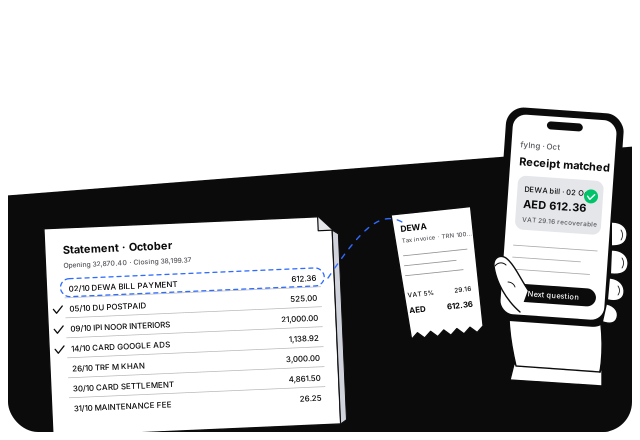
Bank reconciliation means checking every line on your bank statement against your books and documents until both closing balances agree. Do it monthly. Differences come from timing (uncleared cheques and deposits), entries you never booked (bank charges, gateway fees, FX) and errors. In the example below, AED 203.67 of unbooked items explains the gap.
Facts checked 20 Nov 2026 against FTA and Ministry of Finance sources listed at the end. Not tax or legal advice.
Upload a bank statement and your receipts. No sign-up, deleted after 24 hours.
Or start free, no cardWhen the FTA audits a small business, the bank statement is the first thing that gets laid next to the VAT return. Sales in the return should explain the money that came in. Expenses with input VAT should line up with money that went out. Reconciliation is doing that check yourself, every month, before anyone else does it for you. Below is a full walk-through on an illustrative October statement for a small Dubai studio.
What is bank reconciliation, and why does it matter for UAE tax?
Bank reconciliation is the monthly check that your books and your bank agree, line by line and on the closing balance. It matters because UAE tax law requires records that let the FTA verify your obligations, and the bank statement is the independent record those obligations are tested against.
Cabinet Decision 74 of 2023, the Executive Regulation of the Tax Procedures Law, lists "payments and receipts, purchases and sales, revenues and expenditures" as records every business keeps, together with the invoices and contracts behind them. A reconciled month shows three things at once:
- Completeness. No sale is missing from your records, which protects your output VAT and revenue figures.
- Support. Each expense has a document. Input VAT needs a valid tax invoice, not just a card debit.
- Accuracy. The AED amounts in your books are what the bank actually moved, including FX and fees.
What does a UAE bank statement export look like?
Most UAE banks let you export a statement to Excel or CSV from online banking. The file usually starts with several rows of account details before the real table, uses day-first dates and splits amounts into debit and credit columns, with a running balance on every line.
A typical export opens with something like this before the first transaction:
Account StatementAccount Name: PALM LINE STUDIO LLCIBAN: AE07 0260 0010 1500 0000 000Currency: AEDPeriod: 01/10/2026 to 31/10/2026Opening Balance: 32,870.40Date | Description | Debit | Credit | Balance
Six rows of preamble, then headers. Spreadsheet imports often take row 1 as the header and produce nonsense. Here is the October table itself, for a fictional company, with figures chosen to show the usual problems:
| Date | Description | Debit () | Credit () | Balance () |
|---|---|---|---|---|
| 02/10/2026 | DEWA BILL PAYMENT | 612.36 | 32,258.04 | |
| 05/10/2026 | DU POSTPAID | 525.00 | 31,733.04 | |
| 09/10/2026 | IPI NOOR INTERIORS LLC INV 1043 | 21,000.00 | 52,733.04 | |
| 12/10/2026 | POS ENOC 1132 AL QUOZ | 180.00 | 52,553.04 | |
| 14/10/2026 | CARD GOOGLE ADS USD 300.00 | 1,138.92 | 51,414.12 | |
| 20/10/2026 | CHQ 000417 PRESENTED | 15,000.00 | 36,414.12 | |
| 26/10/2026 | TRF M KHAN | 3,000.00 | 33,414.12 | |
| 28/10/2026 | SALIK AUTO RECHARGE | 50.00 | 33,364.12 | |
| 30/10/2026 | CARD SETTLEMENT MERCHANT 4471 | 4,861.50 | 38,225.62 | |
| 31/10/2026 | MONTHLY MAINTENANCE FEE INCL VAT | 26.25 | 38,199.37 |
Closing balance per bank: AED 38,199.37. Figures are illustrative.
How do you reconcile a bank statement, step by step?
Start from the statement, not from your books. Tick each bank line against an entry and a document, then work out why the remaining differences exist.
- Check the statement is whole. Opening balance must equal last month's closing balance, and each line's balance must equal the previous balance plus or minus the amount. A jump means a missing page or a second export with a different date range.
- Tick bank lines to book entries. DEWA 612.36 and du 525.00 match bills already entered. The Noor Interiors receipt matches sales invoice 1043.
- Attach documents. DEWA, du and ENOC give tax invoices with a supplier TRN. Google Ads needs the monthly invoice downloaded from the ads account; it is billed from abroad, so it goes through reverse charge.
- Explain lines with no entry. The AED 26.25 maintenance fee and the gateway fee inside the card settlement are not in the books yet.
- Ask about the unclear ones. "TRF M KHAN, AED 3,000" could be a freelancer, a salary advance or the owner. Each answer means a different account, and a different VAT and corporate tax result.
- List the timing differences. Items in the books that the bank has not processed yet: issued cheques not yet presented, deposits not yet cleared.
- Prove it. Adjusted bank balance must equal adjusted book balance, to the fils.
Worked example: making October agree
Palm Line's cash book shows AED 42,078.04 at 31 October. The bank shows AED 38,199.37. The difference is AED 3,878.67.
| Bank side | AED |
|---|---|
| Closing balance per statement | 38,199.37 |
| Add: customer cheque deposited 31 Oct, not yet cleared | 5,250.00 |
| Less: cheque 000418 to Gulf Print, issued 29 Oct, not yet presented | -1,575.00 |
| Adjusted bank balance | 41,874.37 |
| Book side | AED |
|---|---|
| Closing balance per cash book | 42,078.04 |
| Less: monthly maintenance fee (AED 25 + AED 1.25 VAT), not booked | -26.25 |
| Less: card acquirer fee, sales were booked gross at AED 5,000 | -138.50 |
| Less: FX difference, Google Ads booked at an estimated AED 1,100.00 | -38.92 |
| Adjusted book balance | 41,874.37 |
Both sides agree. The three book-side items (AED 203.67 in total) are now journal entries. The two bank-side items are timing only and should clear in November. If they do not, follow them up.
Note what the reconciliation also told us for VAT: the bank fee carries AED 1.25 of input VAT, the acquirer's invoice should show VAT on its fee, and the Google Ads line needs its reverse-charge entry in boxes 3 and 10 of the VAT201.
Which differences come up most in UAE accounts?
Most differences fall into a short list. Learn to recognise them and a reconciliation takes minutes rather than an afternoon.
| Difference | What it looks like | What to do |
|---|---|---|
| Post-dated cheques (PDCs) | Rent or supplier cheques written months ahead | Keep a PDC register; book each cheque when presented; list issued-but-unpresented ones as outstanding |
| Card settlements net of fees | One credit from a card acquirer or Stripe for many sales, minus fees | Book sales gross, fees as an expense, and match the settlement report |
| FX on card spend | USD or EUR charge arrives at a different AED amount | Book what the bank charged; keep the foreign invoice |
| Bank charges | Maintenance, transfer, chequebook and returned-cheque fees | Book them monthly; they usually include 5% VAT |
| Transfers between own accounts | Money from the AED account to the USD account or a savings account | Not income, not expense; both sides must appear |
| Marketplace payouts | Noon or Amazon.ae payouts net of commission and returns | Use the platform's payout report as the document |
| Personal spend | Supermarket, school fees, family transfers from the business account | Owner drawings, no input VAT; see personal vs business expenses |
How do you match receipts and invoices to bank lines?
Match on amount first, then date, then the name. Exact amounts in AED are the strongest signal; dates and names break ties.
- Amount. AED invoices should match to the fils. Foreign-currency charges need a tolerance, because the bank's rate and any card fee move the AED figure by a few percent.
- Date window. A receipt is usually paid on the day or within days. A supplier invoice can be paid weeks later on 30 or 60 day terms. Use a short window for receipts and a long one for invoices.
- Name. Bank descriptions are truncated and noisy ("POS ENOC 1132 AL QUOZ"). Ignore words like LLC, FZE, POS and city names, and compare what is left.
- One to one. Each document pays one line. Two identical DEWA amounts in a month need two bills, not one bill used twice.
How often should you reconcile?
Monthly, within two to three weeks of month end. VAT returns for most small businesses cover a quarter and are due by the 28th day after it ends, so three reconciled months leave a few calm days to file. Statements and documents then go into the archive for at least 5 years for VAT and 7 years for corporate tax; the full rules are in how long UAE businesses must keep records.
Common reconciliation mistakes
- Forcing the balance with a "suspense" or "difference" entry and never coming back to it.
- Booking card settlements net, so sales (and output VAT) are understated by the fees.
- Treating a transfer from the owner's personal account as income instead of owner capital or a loan.
- Reconciling only the main account and forgetting the credit card, the USD account or the PayPal balance.
- Reconciling from a PDF with a missing page. Always check the running balance follows on.
- Leaving unpresented cheques on the list for months without asking why the supplier has not banked them.
How fylng handles this
fylng does the mechanical part of reconciliation. Upload the bank export (CSV, Excel or PDF): the reader finds the header row below the bank's preamble, handles day-first dates and debit/credit or Dr/Cr columns, picks up the IBAN or account number, skips a file you uploaded before, adds only the new lines from an overlapping statement, and flags every point where the running balance does not follow on.
Receipts and invoices are matched one to one with bank lines by amount, a date window (short for receipts, longer for invoices), an FX tolerance for card charges in foreign currency and supplier-name similarity. Lines nobody can explain become plain questions, such as "What was AED 3,000 on 26 Oct for?", answered with two dropdowns. The readiness score shows how complete each period is: statements complete, lines sorted, spend covered by receipts and documents valid. fylng does not yet keep a PDC register or a formal reconciliation statement with outstanding items; for now, list those yourself.
FAQ
What is bank reconciliation in simple terms?
It is checking that every line on your bank statement is in your books, every payment in your books has cleared the bank or is explained, and the two closing balances agree once timing differences such as uncleared cheques are listed.
How often should a UAE business reconcile its bank account?
Monthly. VAT returns are usually quarterly and due by the 28th day after the period ends, so reconciling each month leaves time to chase missing invoices before the return is due.
Is bank reconciliation required by UAE law?
No law uses the words bank reconciliation, but the Tax Procedures Law and its Executive Regulation require records that let the FTA verify your tax position, including records of payments and receipts and the documents behind them. Reconciliation is how you prove those records are complete.
How do I treat post-dated cheques in a reconciliation?
A PDC you have issued is recorded when it is presented to the bank. Until then, list it as an outstanding cheque if it is already in your books, and keep a separate PDC register so future cheques are not forgotten.
Why does my card payment in USD not match the invoice?
The bank converts at its own rate and may add a foreign transaction fee, so a USD 300 invoice can arrive as about AED 1,100 to AED 1,140. Book the AED amount the bank actually charged and keep the foreign invoice as the document.
What if the bank balance in my books is higher than the statement?
Look first for bank charges, payment gateway fees and FX differences that were never booked, then for uncleared deposits, duplicated entries and a missing statement page where the running balance jumps.
Sources
- Cabinet Decision 74 of 2023 (Executive Regulation of the Tax Procedures Law) and amendments, Articles 2 to 4, FTA (checked 20 Nov 2026)
- Federal Decree-Law 8 of 2017 on VAT, as amended, Article 78 (records), FTA (checked 20 Nov 2026)
- VAT Executive Regulation, Article 59 (tax invoices), FTA (checked 20 Nov 2026)
- Filing VAT returns and making payments, FTA (checked 20 Nov 2026)
- Federal Decree-Law 47 of 2022 on Corporate Tax, Article 56 (7-year records), Ministry of Finance (checked 20 Nov 2026)
- Cabinet Decision 40 of 2017 on administrative penalties, as amended, Ministry of Finance (checked 20 Nov 2026)