fylng / Industries / Logistics and freight
Accounting software for logistics companies in the UAE
Every shipment.
The right rate.
A container from Shanghai to Jebel Ali is zero-rated. The truck from the port to your client's warehouse in Al Quoz can be zero-rated too, if it is part of the same job. A van run from Dubai to Abu Dhabi is 5%. The customs duty you paid for a client is not your income at all. fylng sorts every leg and every pass-through cost, so your VAT201 matches your job files.
In the UAE, transport of goods that starts or ends outside the country is zero-rated, together with the transport-related services that go with it: handling, customs paperwork, loading and a UAE leg sold by the same supplier. Purely local transport and stand-alone storage are 5%. Customs duty and fees paid in a client's name and recharged at cost are disbursements, not revenue. A registered agent that imports for an unregistered client pays the import VAT through its own return and cannot recover it.
Key facts for logistics companies
Why freight books go wrong quietly
A forwarder can run a hundred jobs a month, each with five charges at two VAT rates and money passing through for customs. The bank statement shows none of that.
Two rates on one invoice
Sea freight and terminal handling at 0%, storage after delivery at 5%, duty passed through with no VAT. One wrong line and the whole job is in the wrong box.
Money that is not yours
Customs duty, port fees and deposits you pay for clients go through your bank. Book them as income and your revenue, and your corporate tax, are inflated.
Who did the local leg?
The truck from Jebel Ali to the client is zero-rated if you sold the whole move. If the client hired a separate haulier, that haulier charges 5%. Same truck, different answer.
Import VAT for clients
Clear goods for a client with no TRN and the import VAT lands on your own return, with no right to recover it. Miss the recharge and it is your cost.
Diesel, tolls, fines
ENOC and ADNOC fuel carries 5% you can recover. Salik, RTA permits and traffic fines carry no VAT at all. Most spreadsheets treat them the same.
Drivers and subcontractors
Driver salaries through WPS, accommodation, visa costs and cash advances, plus owner-drivers paid by transfer. Each has a different VAT and corporate tax treatment.
The UAE rules that matter for logistics
The law is the same for every business; these are the parts a freight ledger meets every week. Each rule links to the official text.
International transport of goods is zero-rated
Transport of goods that starts or ends in the UAE, or passes through it, is zero-rated together with transport-related services (Article 45, Clause 2 of the VAT Decree-Law). The Executive Regulation covers goods moved from the UAE to abroad and from abroad into the UAE (Article 33). Arranging that transport, and insuring the goods in transit, are zero-rated too. [1][2]
Example. Sea freight Jebel Ali to Mombasa, billed to a Dubai exporter: 0%, box 4.
The UAE leg is zero-rated only if you sold the whole move
Moving goods from one place in the UAE to another is zero-rated only when the same supplier also supplies the international leg (Executive Regulation, Article 33, Clause 1(d)). A haulier you subcontract to truck a container from Jebel Ali to Al Quoz charges you 5%, even though your own bundled charge to the client is 0%. [2]
Transport-related services follow the freight
The Decree-Law lists shipment, packing and securing cargo, preparing customs documents, container management, loading, unloading, storing and moving goods as transport-related services (Article 1). Their place of supply is the same as the transport they relate to (Executive Regulation, Article 22), so they are zero-rated with an international move. Storage or packing sold on its own, after the move has ended, is a normal 5% service. [1][2]
Local transport and courier work: 5%
Moving goods within the UAE with no international leg in the same supply, last-mile deliveries, removals and local courier runs are standard-rated at 5%. Where a trip has several stops, each leg is taxed where it starts. Local passenger transport is exempt, but that is a passenger rule, not a goods rule. [1]
Customs duty paid for a client is a disbursement
VAT is charged on the consideration for your own supply (Article 34). Duty, customs fees and port charges you pay in the client's name, as its agent, and recharge at exact cost are not part of your service: no VAT, and not your revenue. A charge you mark up, or one you incur in your own name to deliver your service, is part of your fee and takes the rate of that fee. If unsure about a particular charge, check with the FTA. [1]
Clearing for a client with no TRN: the import VAT is yours to pay
A registered client gives its TRN and customs code and accounts for import VAT itself (Executive Regulation, Article 48). If the importer is not registered and a registered agent imports for it, the agent pays the import VAT through its own return as if it were the importer, cannot recover it, and gives the client a statement with its TRN, the import date, the goods and the tax paid (Article 50, Clauses 4 to 8). [2]
Example. Goods worth 52,000 with 2,600 duty: import VAT 2,730 on your return. Recharge it, and keep the statement you issue.
Transit, bonded warehouses and designated zones
Goods in transit, in a customs warehouse or held for re-export by the same person are not imported while they stay under customs suspension (Executive Regulation, Article 47). Goods can move between designated zones without VAT (Article 51 of the Decree-Law). But services supplied inside a designated zone, such as storage for a local client, are inside the UAE and taxed normally unless they relate to an international move. [1][2]
Trucks, fuel and tolls
Zero-rating of means of transport covers commercial aircraft, ships and buses for ten or more passengers, not trucks or vans (Executive Regulation, Article 34), and fuel is excluded from the related zero rate (Article 35). So diesel and truck purchases carry 5%, which you recover with a valid tax invoice. Salik tolls, RTA permits and fines are government charges with no VAT. Vehicles available for staff personal use are blocked (Article 53). [2]
Driver accommodation: recovery narrowed from 1 October 2026
Cabinet Decision No. 149 of 2026 limits input VAT on staff accommodation to cases where the employer is required to provide it, for example by MoHRE rules, or under a documented policy that meets the FTA's conditions. The same decision blocks recovery on supplies paid in cash above a threshold that a ministerial decision will set. [4]
Foreign software and platforms: reverse charge
Fleet tracking, load boards, freight booking platforms and other services bought from suppliers with no UAE establishment are reverse charged (Article 48 of the Decree-Law): 5% in box 3 and, if fully taxable, the same in box 10. Since 1 January 2026 you keep the supplier invoice and payment record instead of a self-invoice. [1][2][7]
Corporate tax: logistics can qualify in a free zone
A UAE logistics company pays 9% on taxable income above AED 375,000, or uses Small Business Relief if revenue is AED 3 million or less, for periods ending by 31 December 2029. In a free zone, logistics services count as a qualifying activity for the 0% rate: storage and transport of goods for others without taking title, including cargo handling, warehousing, customs brokerage and freight forwarding (Ministerial Decision No. 229 of 2025). The CT exemption for shipping and airlines (Article 25) is for non-resident operators only. [3][5][6]
Revenue for corporate tax, the AED 375,000 VAT test and the AED 3 million Small Business Relief limit is your own fees, not the duty and deposits that pass through your account. Keep disbursements in their own ledger from the first job.
Your jobs, sorted line by line
This is how a quarter looks for a sample freight company in fylng. Each bank line gets a category, a VAT treatment and a status, and anything unclear becomes a plain question.

What was AED 1,500 to Ahmed Khan on 16 Aug for?
- Disbursements apartCustoms duty and fees paid for clients are kept in their own account, so revenue shows your fees only.
- Two rates, one clientA client payment that covers 0% freight and 5% storage is flagged for a split against the job invoice.
- Plain questionsRound transfers to drivers and owner-operators come back as one question, not a guess.
Sample company and figures, for illustration. The screens follow the fylng app layout.
One job, three treatments
The figures below are an example, not a real forwarder. They show how one invoice to one client mixes zero-rated, standard-rated and pass-through amounts.
Example: a 40-foot container from Shanghai to a Dubai importer
The forwarder sells the whole move door to door, clears the goods and stores them for ten days after delivery. The client is VAT registered and uses its own customs code.
Box 4 gets 9,400 of zero-rated supplies and box 1 gets 600 with 30 of VAT. Revenue is 10,000, not 14,030: the 4,000 of duty is the client's cost. Booking the whole receipt as income overstates revenue by 40% and pushes the company towards the VAT and Small Business Relief thresholds early. If the client had hired its own truck, that haulier would charge 5% on the 900. Where you only clear goods and do not move them, check the rate with the FTA.
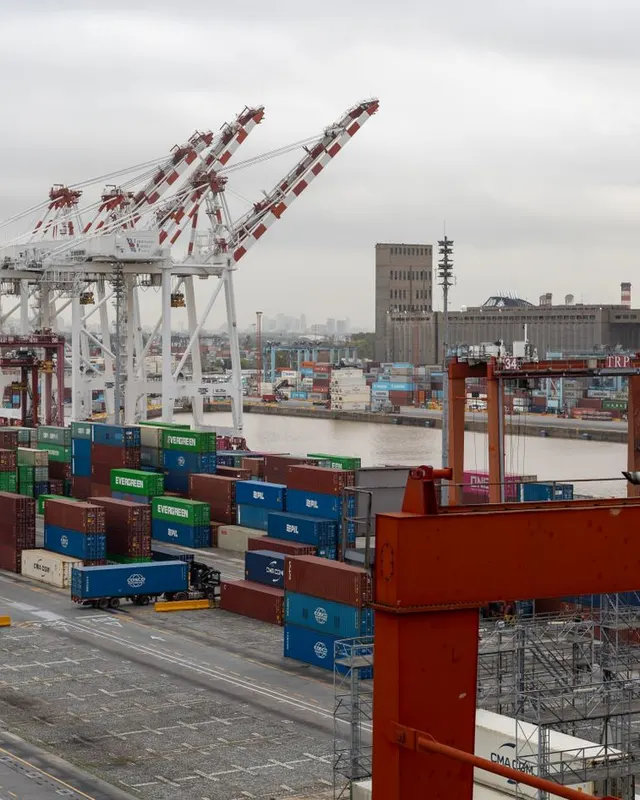
Every container is a job with four or five charges at two VAT rates and money that belongs to someone else. The books should see it the way your job file does.
Photo: Rafael Rodrigues on PexelsWhich charge takes which rate
A starting point for the usual lines on a freight invoice. The facts of each job decide; when a charge is not linked to an international move, it is normally 5%.
| Charge | Linked to an international move | Stand-alone in the UAE | Where it goes |
|---|---|---|---|
| Sea, air or road freight | 0% | 5% (domestic only) | Box 4 or box 1 |
| Terminal handling, loading, container management | 0% | 5% | Box 4 or box 1 |
| Customs documentation and clearance | 0% as part of the move | Check with the FTA | Box 4 or box 1 |
| UAE truck leg | 0% if you also sell the international leg | 5%, including subcontracted hauliers | Box 4 or box 1 |
| Warehousing | 0% while part of the transport | 5% once the move has ended | Box 1 by emirate |
| Cargo insurance arranged for the client | 0% | Depends on the policy | Box 4 |
| Customs duty, port deposits paid in the client's name | Disbursement at cost | Disbursement at cost | Not in the return, not revenue |
| Import VAT for an unregistered client | Paid through your return, not recoverable | Your return; recharge and issue a statement |
What fylng does for logistics
Straight answer on what works today and what is on the way.
Working today
- Reads bank statements from any UAE bank (CSV, Excel, PDF) and flags gaps in the running balance
- Sorts fuel, tolls, fines, customs payments and shipping line invoices, and turns unclear lines into a plain question
- Salik, RTA fees and fines kept out of VAT; diesel and truck costs recover 5% only with a valid tax invoice
- Matches supplier and client invoices to bank lines by amount, date window and name; supplier TRN checked
- Reverse charge in boxes 3 and 10 for foreign software and platforms
- VAT201 values box by box and by emirate, a readiness score and a corporate tax estimate with Small Business Relief check
Before you file your next VAT return
Work through it once a quarter. Your ticks stay in this browser.
Mistakes we see most often
Booking customs duty as income
Revenue and corporate tax are overstated, and the Small Business Relief limit is reached early.
Zero-rating every truck run
A local leg is 0% only as part of your own international move. Otherwise it is 5%.
Zero-rating storage that stands alone
Once the move is over, storage is a local service at 5%.
Claiming import VAT paid for a client
Import VAT you paid for an unregistered client is not your input tax. Recharge it.
Claiming VAT on Salik and fines
There is none to claim. Only fuel, repairs and services with a tax invoice.
Paying drivers in cash without records
No WPS trail and no proof for the deduction, and the new cash-payment rule may block input VAT.
Free file tools from FixDoks, our sister product.
Questions
owners ask
What is the best accounting software for logistics companies in the UAE?+
One that knows which freight charges are zero-rated and which are 5%, keeps customs disbursements out of revenue and handles import VAT paid for clients. fylng does this from your bank statements and invoices and gives you VAT201 values; job-level import from forwarding systems is on the way. You can try it free.
Is freight forwarding zero-rated in the UAE?+
International transport of goods that starts or ends in the UAE is zero-rated, and so are related services such as handling, customs paperwork, loading and arranging the transport. Purely local transport is 5%.
Is the truck from the port to my client zero-rated?+
Yes if you also supply the international leg of the same move. If the client or you hire a separate haulier for that leg, the haulier charges 5%.
Do I charge VAT on customs duty I pay for a client?+
Not when you pay it in the client's name as its agent and recharge the exact cost. It is a disbursement: no VAT, and not your revenue. A marked-up charge is part of your fee.
Who pays import VAT when I clear goods for a client?+
A VAT-registered client accounts for it with its own TRN and customs code. For an unregistered client, a registered agent pays it through its own return, cannot recover it and must give the client a statement of the tax paid.
Is warehousing zero-rated?+
Storage that is part of an international move is a transport-related service and can be zero-rated. Storage sold on its own, or after the move has ended, is 5%.
Can I recover VAT on diesel and trucks?+
Yes, with a valid tax invoice, as they are used for taxable supplies. Salik tolls and fines carry no VAT. Cars available for staff personal use are blocked.
Does e-invoicing apply to freight companies?+
Business-to-business invoices are in scope from 1 January 2027 for revenue of AED 50 million or more and from 1 July 2027 for others. International air cargo documented with an airway bill is excluded for the first 24 months.
Sources
- Federal Decree-Law No. 8 of 2017 on VAT, with amendments (FTA consolidated PDF)
- Cabinet Decision No. 52 of 2017, VAT Executive Regulation, with amendments (FTA consolidated PDF)
- Federal Decree-Law No. 47 of 2022 on Corporate Tax (MoF PDF)
- MoF: amendments to the VAT Executive Regulation (Cabinet Decision No. 149 of 2026: staff accommodation, cash payments)
- MoF: Small Business Relief extended to 31 December 2029
- Ministerial Decision No. 229 of 2025 on Qualifying and Excluded Activities (MoF PDF)
- MoF: VAT law amendments in force from 1 January 2026 (Federal Decree-Law No. 16 of 2025)
- MoF: UAE e-invoicing programme
Every shipment, the right rate.
The free check reads a bank statement and shows your readiness score and VAT at stake. No card, no sign-up.